
More Garden Notes
Sept 2026
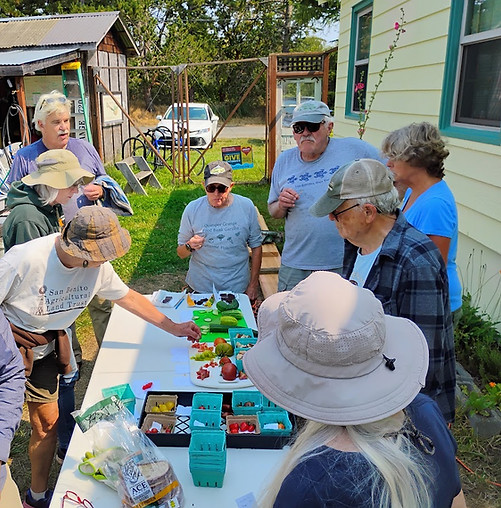
Mary, Louise, Ben, Seth, Dave, Tammy, Marty and Teya sample various types of tomatoes & cukes for our annual 'taste-off'. The overall winners : "Aunt Ruby's German Green" tomato and "Tasty Green" cucumber.
The end of August closed our peak growing season like a wind-slammed door. Pole and bush beans, cukes, summer and winter squash all stopped in their tracks like a referee's time-out whistle had been blown. A few things are hanging on for another few weeks - the outdoor tomatoes show promise in ripening a bit more before we cut them and hang them inside the hoop house to finish their job. Spinach, lettuces and scallions are grateful for the cooler weather. And so are we.
According to the program we use to guide us, Grow Veg, seeds that we can still sow in the ground are:
Sept 1-15 - chard, dill, kale, collards, mustard
Mid Sept - Mid Oct - leaf lettuce, radish, turnip, carrot, cilantro, spinach, bok choi, scallions, arugula
Oct 1 - Mid Nov - garlic, fall planted onion
Nothing is guaranteed, however. We can't control the weather, but we can control some protections for our precious crops. Some of these veggies we plan to grow indoors to extend the growing season and to protect from bugs, birds, etc. And others we'll cover with a lightweight (Remay) cloth against the cold.
A Parting Note...

Upon arriving at the garden today. Chased out.

And a few hours later... finally found the hole in the fence!
Quimper Grange Food Bank Garden
aka "Jo's Garden"
In Memoriam ~ Jo Yount
June 20 1937 - July 9 2026
Our beloved Grange member and first Quimper Grange Food Bank Garden Manager, Jo Yount has passed on to her next adventure.
A memorial service will be held at the Quimper Grange on Sunday, August 23rd starting at 11 am with a pot luck meal, music, and memories.
That eyebrow raise.
That twinkle.
That unstoppable energy.
That level of caring.

Jo Yount was a force of energy for Quimper Grange and beyond. She was an avid and adventurous outdoors person, creative in her solutions to many problems, and devoted to her Christian Science Church faith.
She and her husband George helped reboot the Grange when it was in danger of being closed. They made it possible to get the roof and windows replaced, and they ran the contra dances for many years until the Covid pandemic put a pause on everything.
The Grange was in Jo’s heart. She found quilting medallions from a vintage project and had artfully affixed them on insulated shades for all the Grange windows. In 2025, the shades were worn beyond repair and replaced, but the medallions were rescued and cleaned for a future display.
In 2012 Jo created the Quimper Grange Food Bank Garden in order to further serve her community with fresh food for the food banks. She shared her gardening expertise with any who wanted to learn about feeding ourselves and our community. Today, the garden hosts a trellis and bench dedicated to her spirit, and feeds hundreds of people throughout the year at the food banks and other organizations.
From Kathy Ryan:
"I met Jo in 2014, through my second friend in PT who upon hearing I had worked on farms on the east coast thought I could be useful.
I got to know Jo when she needed a driver and we spent just about every day in the garden. She amazed me with her knowledge of how to use amendments. Her beds were always prolific. I loved her stories. She talked about her weekly prison visits, raspberries, her sewing projects, recipes, friends like Tinker, gratitude for starts from Judy at Dundee Hill, and how to space different plants using only her hand. She welcomed my grandchildren as warmly as she did all volunteers and taught them the difference between herbs, veg, and weeds, how to get all the weed root, how to harvest without causing damage. And she made it fun. She always talked with them as equals. It inspired my granddaughter to start a garden at home, and she reveled in her first carrots."
The Quimper Grange Food Bank Garden was known by volunteers as Jo’s Garden for the hours she dedicated to growing and sharing, especially her flowers and signature salad mixes. In 2024 the QG Garden asked the Community Boat Project to create an arbor for Jo: this has become a memorial to her passion.
Lys Burden, considered the Founding Mother of the Food Bank Growers shared this:
"In the formative years of Food Bank Growers, we used to meet monthly at Jo and George's house for reviewing our finances and sharing what was going on in our production gardens. In those years we only had three sites at Mountain View Commons, Port Townsend High School and Quimper Grange and about 7 people participating. Sometimes we would bring pot-luck snacks, and Jo would provide herbal tea. It was a time of organizational establishment and learning better techniques for high production yields. We had fun sharing our wins and discussing our challenges. Lots of ideas crystallized and solid information about best gardening practices flowed from our mentor, Jo Yount. She was an invaluable leader and participant in the project's growth and success."
Jo was active in the Christian Science Society, building and managing the Blessings Garden with Judith Johnson who shared this story:
"We started the Garden in 2004, mostly just the two of us. I told Jo it was the best soil I had ever worked. I also helped her in her own landscape when we entered it into the Master Gardener Secret Garden gala. She and I graduated from the same MG class, but I only got to know her through church. We had a wonderful time growing flowers and veggies together. I introduced her to Aunt Ruby’s German Green tomato that she so enjoyed."
Jo may have passed, but what a full rich life she shared! Her many gifts will keep on giving to the community that she loved.
Quimper Grange Food Bank Garden is one of a number of Food Bank Growers gardens in East Jefferson County to Grow, Gather and Give nutritionally-dense fruits and vegetables to build healthy, vibrant communities, improve food security, and decrease food waste for our Jefferson County neighbors. See FoodBankGrowers.org for more info.


More Garden Notes June 2026
Things got really busy these past two months planning, prepping and planting for TWO food bank gardens!
Of course, the Grange garden - near & dear to our hearts - deserved our full attention. But so did the Blessings garden - just down the road from us on Umatilla.
Mary Beth, Mary G and Barbara tended that garden a number of years ago when Judy was vacationing in Alaska. We fell in love with its beauty and productivity. So when Judy announced she needed to 'retire' from the garden, we leaped at the chance of tending it just one more year. And we are doing just that.
Blessings Garden is now fully planted with potatoes, leeks, onions, beets, onions, shallots, winter squash, sweet potatoes and beautiful pollinator flowers. We are fortunate to have Kathy & Herb tending to Blessings' asparagus and raspberry beds there, as well as their managing of the Co-Op Garden.
We're already harvesting beet greens, lettuce & scallions from this amazing garden - with so much more to come!
If you want to support any of FBG gardens, please visit our website at FoodBankGrowers.org. You can even purchase a beautiful tshirt through our website. If you see other people with this t-shirt, they are one of our fan club!

Garden Notes May 2026
From the beginning of Food Bank Gardens, plant propagation for garden sites fell on the shoulders of Garden Managers, adding yet another responsibility to an already demanding role that includes planning, recruiting volunteers, and preparing garden spaces for the growing season—not to mention commitments such as Master Gardener plant sales and their own home gardens. By 2025, it became clear that the organization would benefit from a centralized propagation service to support those who needed it.

The FBG Propagation Team: "PropaGators" Mado, Seth and Kim
With us since January 2026
That need led to the creation of the FBG Propagation Team—affectionately known as the “PropaGators.” Since building a fully operational propagation facility in early 2026, the team has quickly become an instrumental force within the organization, serving seven gardens and producing thousands of vegetable starts in just a few short months.

"I volunteer because helping to provide nutritious food to members of my community helps support and strengthen local food systems while providing delicious nutrient dense produce to those who need it."
Mado Most
Led by Mado Most, the team includes Seth Katz-Monet and Kim Duddy. The Grange Garden has played a vital supporting role by providing a hoop house and a wide range of supplies. Special thanks to Barbara Tusting and Mary Beth Haralovich for their continued support of this initiative while managing both the Grange Garden and Blessings Garden.
On any given day, the propagation team can be found seeding trays, monitoring germination conditions, transplanting seedlings, and coordinating distribution schedules to ensure each garden receives the plants it needs at the right time. Their work requires careful planning, attention to detail, and a deep understanding of seasonal growing cycles in East Jefferson County.
The propagation effort has significantly reduced the burden on Garden Managers while also strengthening collaboration across garden sites. By centralizing early-stage growing, individual gardens are able to focus more energy on cultivation, maintenance, and harvests later in the season. The result is a more efficient use of resources and a greater overall yield for the communities we serve.
Looking ahead, the team continues to explore ways to improve both their facility and their service. Planned enhancements include the addition of innovative equipment such as solar-powered vents and fans, helping to increase efficiency, sustainability, and overall capacity as the program continues to grow.

ENDORSEMENT: "This is an especially busy year for me, and I am so grateful to know that the PropaGaters are willing to take my seed-starting requests and then care for the seedlings until it’s time to plant. I keep telling everyone that the Prop Squad has saved my life this spring — or at least my sanity. All I have to do is show up and claim my beautiful seedlings when they are ready. Keep up the excellent work, Prop Team!" ~ Suzanne E, Swan
Garden Notes April 2026
You may have noticed our new logo! Although we are subsidized and lovingly supported by Quimper Grange #720, our mothership is Food Bank Growers through which we obtain funding, person-power, and the ability to request grants. We are only one of eleven other Food Bank Growers Gardens in East Jefferson County.
If you want to support any of FBG gardens, please visit our website at FoodBankGrowers.org. You can even purchase a beautiful tshirt through our website. If you see other people with this t-shirt, they are one of our fan club!
The Grange garden had a particularly good winter harvest through March with our dedicated crew. Here's what we had just this year, January - March:Not only is this such great news, but our total winter harvest (Nov 2025-Mar 2026) was 375#!
This success is largely due to hoop houses that keep things warmer, but mainly due to our base volunteer crew that shows up once or twice every week rain or shine without fail.
It's not too late to plant potatoes, but you need to get a move-on. Depending on the type, they like to be planted DEEP, 6-8". They they like to be 'hilled up' a few times during the growing season, piling more dirt or compost or straw around the plant so that only the top is showing.
This is the time that we're putting in a lot of beets, too. Despite the fact that not everyone loves them (including me!), I know that they're high in nutrition, both beetroot and the tops. The tops are easy - just chop up & stirfry - and I do like beets roasted with herbs until soft.
It's a good time to start a flat of basil indoors - they really love heat, so starting them too early is tempting, but there's still a couple of weeks to do so indoors.
A lot of veggies can be started by seed outdoors now, which is what we at the Grange will be doing in the next few weeks:
Bush beans, pole beans, artichoke, carrots, winter & summer squash, sugar snap peas... the list goes on. If you're starting from seed, do read the instructions for improved chance of success.
Garden Love
by Juliana Horatia Ewing (1841-1885)
Every child who has gardening tools,
Should learn by heart these gardening rules:
He who owns a gardening spade,
Should be able to dig the depth of its blade.
He who owns a gardening rake,
Should know what to leave and what to take.
He who owns a gardening hoe,
Must be sure how he means his strokes to go.
But he who owns a gardening fork,
May make it do all the other tools’ work
Though to shift, or to pot, or annexe what you can,
A trowel’s the tool for child, woman, or man.
‘‘Twas the bird that sits in the medlar-tree,
Who sang these gardening saws to me.

Garden Notes March 2026
Pop back next month to see what we're doing. It's SO busy! In the meantime see our Garden tab to learn about GroVeg, our new program, and what our growing scheme will look like.
Poem submitted by Kathy D - a garden volunteer...
One Garden
I am no longer surprised
when strange, exotic
blooms appear in my mind,
knowing now how seeds
arrive on the wind from everywhere.
Now, I am less likely to label
something weed simply because
I didn’t plant it myself.
At the same time, I want
to be discerning, knowing
whatever I choose to grow might
appear soon in the soil of you,
so I am cautious when sowing
bulbs of anger, saplings of judgment,
thorns of certainty.
I want us all to plant great beds
of unanswerable questions
and tend the mystery together.
How else might it change
what these hands do when I
trust every choice matters?
—Rosemerry Wahtola Trommer

Garden Notes February 2026
With thanks to Food Bank Growers, a new tool in our garden planning 'toolbelt' is the popular app, GroVeg. A number of FBG gardens have been using it for years, but this holdout would rather struggle with pencil & paper! No longer. We have come into the 21st century with this super-useful app which lets you do all your planning, then tells you which seeds you need and when to start them! Below are some samples of how we can work with our planning for 2026:

Once we decide what we want to grow, we place the vegetable in the row and drag it to fill. The super cool thing is it'll place the plants the distance they need to grow well and tell you how many of each type you'll need to start!

The next super cool use of this program is it'll tell us when we need to plant them, indoors or outdoors, and when to expect to harvest. This information is based on our zip code, and is a critical piece for us.
The learning curve was amazingly easy; the hardest thing was to get our beds measured and the initial template laid out.
Garden Notes January 2026
Starting fresh again in the New Year gives us another year of experience and perspective. Our total harvest for the year was almost 1900 pounds and over 2700 volunteer hours. Our final few harvests of the year were joyful to behold, adding many pounds of FRESH veggies into a depleted market.

Carrots still in the ground and just pulled: Our most consistent with shape and flavor was the Nantes variety of Bolero. Our warmish weather has them keeping their lovely greens well into this winter!

Barb and Robert walked their home harvest to the Garden for our final harvest of the year. Lovely herbs, kale and parsley were so appreciated.


Scott, Derek and Rach stayed a bit warmer inside the hoop house scrubbing the hundreds of carrots pulled this day.
Mado, Susan and Seth are ready to start seedlings for a number of FBG gardens in January in our "Greenhouse". Another volunteer, Dave, built these great benches lining the greenhouse on which we can grow out some veggies in crates. Shown behind them are some baby lettuce & mature pac choi that were just harvested this week.
2025 Garden Wrap-Up
For those who love numbers, here are our top 20 veggies by weight for the year...


Garden Notes December 2025

Our Thanksgiving Harvest was Awesome! We were able to take 44 pounds of food to the Wednesday Food Bank, half of which was carrots. garden volunteers also brought in pounds of herbs, beets and cucumbers; the garden also harvested turnips, stir fry mix, leeks, violet pac choi, and many others. The only thing stopping us from harvesting more was that cold, cold wind. Brrrr.
We continue to grow food in the hoop houses & the greenhouse. Many more pak choi starts are coming along nicely, along with a lot of lettuce, the top request of the food bank volunteers (thank you, Janice!).
We will harvest our outdoor carrots through the winter (despite their damaged leaves) and whatever else presents as we ready for harvest each week.
However, we are facing a lot of damage primarily from cutworm. We have quickly become skilled in search and destroy methods for these awful pests that devour everything under the sun. We've included some photos to help others identify and locate these pests.
We are trying an experiment using Diatomaceous
Earth (a naturally occurring sedimentary rock comprised of fossilized diatoms; these are composed of silica, which scratches the surface of soft grubs and dehydrates them) and Bacillus thurengiensis (a naturally occurring bacteria living in the soil; OMRI rated for a biological control method that is an alternative to chemical pesticides). We are treating the spinach - 1/2 with D.E. and 1/2 with B.t. A number of gardens and nurseries are interested in the outcome of this experiment.
We will continue to harvest our outdoor carrots through the winter (despite their damaged leaves) and whatever else presents as we ready for harvest each week.

A variegated cutworm pupa - Photo by JR Baker, NC State University

Cutworm damage inside Hoop House 1 - destroying our wonderful spinach!

Cutworms come in all colors and sizes. The pale ones were pulled off our snap peas. The baby ones are bright green. Most of the ones shown here were found at night by flashlight, and had stripped the carrot greens down to the main stem. Aaargh!
November 2025 Garden Notes

Summer Sunflowers side-by-side (Before)

Fall garden beds put to sleep, layered with leaves & compost, and seeded with more field peas. (After)
“The beauty of autumn is that it reminds us that even the most beautiful things have to end, and it’s okay.” - Anita Kućma

Fava beans coming up between beet greens, ready to harvest for luscious growing tips

Fall pollinator garden
Putting the Grange garden to ‘bed’ for the winter takes as much care as tending it during the warmer months. It’s yet another joyful time in the garden, with people pulling weeds, planting new food crops to grow over the winter, and replacing existing covers with more substantial frost-resistant ones. We delight in seeing the newly-planted cover crops emerging, some now ready to harvest for winter greens! We also delight in these crops, as we don’t need to tend them as often, very handy in the winter months!
Cover crop provides the soil much-needed protection from the heavy rains and freezing temperatures. Some of the cover crops (like fava beans and field peas) can be continually harvested for their tasty and nutritious greens throughout the winter. Other cover crops, like the rye/vetch mix we use, and crimson clover, will add ‘green manure’ when it’s time to terminate it in the spring. All the cover crops will be chopped in weeks before planting next year; some, including the vetch, peas & fava, will add nitrogen to the soil though their rhizobia bacteria, which fixes atmospheric nitrogen into a form plants can use.
We are still transplanting some veggies outdoors: many pac chois, mustards and lettuces and spinach; those will be covered and harvested this winter and some will provide a nice early start in the spring. Inside the hoop houses we’ve got more carrots, snow peas, more Asian greens, turnips, and a large bed of braising greens.
We are having to do battle with the cutworm again, this time inside one of our hoop houses. They are chowing down on our beautiful spinach that were started in September. To mitigate these cutworms, we are treating part with DE (diatomaceous earth) and part with Bt (Bacillus thuringiensis), an OMRI supported natural biological pesticide. No worries, completely safe to use. Luckily these treatments won’t wash out because the plantings are under cover. It will be interesting to see which is more effective.
Another pest we just discovered was a nasty vole (or two) that has invaded several of our beds. We will first try citrus rinds buried in the soil, then will move on if that doesn’t work. Any suggestions are more than welcome!
This is also a great time to do some indoor chores. Supportive frames are being built inside our greenhouse to support the crates in which we’re growing more food. Tools are being oiled and stored. Fans are being mounted to keep the air flowing in the hoop houses. And we are packaging up a lot of seeds to distribute at a later date.
What's Happening in October
We had such a successful time at the Farm Tour! Our garden was at peak performance with bright orange Kabocha squash, towering heads of sunflowers, and tomatoes of all colors.
Now, a sigh of relief. The push is over and time to ease into planting cover crops and chopping down our tired veggie vines. We're saving seeds from beans and tomatoes, the easiest and most predictable seeds to save. These have been carefully selected for flavor and vigor, and will be dried and stored for next year. Of note, two of our cherry tomatoes, Snowberry and Pink Honeydrop were voted favorites at a recent WSU Seed Saving workshop at our local Oatsplanter Farm.
Irrigation will be turned off to our outside beds sometime this month, pending weather patterns. Hand watering will still be appropriate in some areas, especially new starts, but then our rain showers will take care of the rest.
As the cooler weather sets in, volunteer activity will wane, and that's OK. Volunteers, just like our soil, need a time to rest and replenish their energy. We cancel garden hours in bad weather and just catch up the next time.
Self Care for the Autumn Gardener
Dress in layers, and be outdoors as much as possible. Scuffle through fallen leaves. Walk in the rain. Experience the beauty of our northwest storms from the warmth & safety of the indoors, or the excitement of being outdoors in it.
After a summer of companionship and social activity, lets not isolate ourselves. Reach out. Gather in small groups. Play games.
Go listen to live music. Cook for others.
Above all, stay healthy :)

In April 2025, the Port Townsend Food Co-Op issued a grant through the Farmer's Fund to create an All-Access garden bed area. This bed serves those who are no longer able to kneel, squat, or sit on the ground. This wonderful addition allows people to stand, sit in a chair, and has three bays that are easily accessible by wheelchair.
This area is now complete with rubber matting installed from the front gate to the beds! We welcome people of all abilities to help us tend this, and other parts of our garden.
Exciting News!


One of five raised beds funded by the Noon PT Rotary Club. This enhanced our winter growing by getting the roots up out of this boggy area of the garden! February 2024.

Friends of Jo and George Yount gather to dedicate the bench to the vision Jo had back at the beginning, to create a garden in which to grow food to feed the community. Her vision stands today as the Quimper Grange Food Bank Garden, or "Jo's Garden" as it's fondly known as, harvests throughout the year to supply our local food bank with fresh produce. The trellis and bench were lovingly crafted and donated to the Garden by Community Boat Project.

Believe it or not...
Hoop houses (in back of image) protect and warm our winter harvest. This is a mid-February harvest for the food bank!


